Uxin SWOT Analysis

Your Strategic Toolkit Starts Here
Uxin faces intensified competition and regulatory pressure but leverages strong digital used-car platform capabilities and data-driven pricing to capture urban markets; short-term margin squeeze masks scalable revenue opportunities. Purchase the full SWOT analysis to access a research-backed, editable Word and Excel package with strategic recommendations, financial context, and investor-ready insights to inform decisions and drive action.
Strengths

Scalable Superstore Retail Model
Uxin shifted to an inventory-owning superstore model, opening large outlets in Xi'an, Hefei, Wuhan, Zhengzhou and Jinan and taking full control of reconditioning and sales.
This standardizes the customer experience and reduces return rates; reconditioning SOPs cut post-sale issues by ~30% in 2024.
By end-2025 Uxin replicated the model across regions, driving transaction volume up ~85% year-over-year and adding RMB 2.1 billion in GMV in 2025.
High Customer Satisfaction and Trust
Uxin sustained an industry-leading Net Promoter Score above 65 for six straight quarters through Q4 2025, signaling strong loyalty and word-of-mouth; this NPS correlates with a 15% year-over-year rise in organic web traffic in 2025.
Transparent practices—10-point vehicle inspections, 180-day warranty coverage, and 24/7 after-sales support—reduced return rates to 2.8% in 2025 and built trust in a once-opaque market.
That trust fuels roughly 40% in-store conversion and supported GMV of RMB 12.4 billion in 2025, improving customer acquisition efficiency and lowering marketing spend per buyer by 22%.

Efficient Inventory Management
Uxin keeps average inventory days at about 30 days, cutting depreciation and financing costs; in 2024 the company reported an inventory turnover near 12x and reduced holding losses by roughly 1.8 percentage points year-over-year.
That performance stems from a data-driven pricing engine and digital management tools that adjust supply to real-time demand, helping free up working capital—Uxin’s inventory-to-sales ratio fell to 0.08 in Q4 2024.

Strategic Government and Industry Partnerships
Uxin partners with municipal governments in Tianjin, Guangzhou, and Yinchuan to co-develop superstores, sharing capex and land with state-owned enterprises; this reduced upfront investment risk and cut site rollout time by about 30% in 2024.
Joint investments give Uxin priority access to logistics hubs and local incentives, boosting used-car inventory flow and raising regional market share to roughly 18% in Tianjin and 12% in Guangzhou as of Q4 2025.
Robust Omni-channel Digital Platform
This integrated model drives higher gross margin per unit and scale advantages over fragmented traditional used-car dealers.
- 320+ physical centers (2024)
- 6.5% online-to-offline conversion (2024)
- ~20% faster transactions vs peers
- Integrated finance & insurance
Uxin hits RMB12.4bn GMV in 2025 with 85% Txn growth, 2.8% returns and 65+ NPS
Uxin’s inventory-owning superstores and omni-channel platform raised GMV to RMB 12.4bn in 2025, with an 85% YoY transaction volume rise and 2.8% return rate; NPS >65 for six quarters and 6.5% online-to-offline conversion (2024) cut CAC 22% and sped transactions ~20% vs peers.
| Metric | 2024 | 2025 |
|---|---|---|
| GMV | — | RMB 12.4bn |
| Return rate | ~4% | 2.8% |
| Inventory days | 30 | 30 |
What is included in the product
 Detailed Word Document
Delivers a strategic overview of Uxin’s internal strengths and weaknesses and the external opportunities and threats shaping its competitive position in the used-car marketplace.

 Customizable Excel Spreadsheet
Delivers a concise Uxin SWOT snapshot to quickly align strategy, highlight operational risks and growth levers, and speed stakeholder decision-making.
Weaknesses

Persistent Operational Losses
Despite revenue rising 28% y/y to RMB 9.6bn in 2025 and EBITDA losses narrowing to RMB -0.3bn, Uxin remained net-loss-making through 2025, reporting a net loss of RMB -0.9bn. The shift to an asset-heavy model needs large upfront capital for inventory and 120+ superstores planned, increasing working-capital strain and depreciation. Turning to sustained net profitability while funding aggressive expansion is a core weakness.
Constrained Balance Sheet
The company’s balance sheet is constrained: cash on hand was RMB 380 million at end-2024 versus RMB 1.8 billion of short- and long-term borrowings, leaving thin liquidity cushions.
Recent equity and debt raises in 2024 provided breathing room, but Uxin still depends on ongoing external funding to sustain growth, a clear vulnerability.
Interest expense ran near RMB 240 million in FY2024, compressing margins and making earnings highly sensitive to credit-market shifts or investor sentiment.

Exposure to Inventory Depreciation

High Dependence on External Financing
Uxin's expansion relies heavily on external capital, highlighted by the $50 million deal with NIO Capital and Prestige Shine signed in December 2025; without similar funding, planned roll-out of 40 superstores in 2026 could stall and burn-rate coverage (current cash runway ~6 months as of Q3 2025) would shrink.
This dependence raises execution uncertainty: funding disruption could delay store openings, push additional debt, or force asset sales, undermining long-term strategy and investor confidence.
- $50M NIO/Prestige Shine deal, Dec 2025
- Planned 40 superstores in 2026
- Cash runway ~6 months (Q3 2025)
- High refinancing and execution risk
Declining Average Selling Price
- ASP down ~9.5% since 2022
- Volume +18% in 2024
- Gross margin pressure ~220 bps
- Need ~12% more transactions to maintain revenue
Uxin shifts to cash‑hungry asset model, loss Rmb0.9bn and 6‑month runway
Uxin remains net-loss-making (net loss RMB -0.9bn in 2025) while shifting to an asset-heavy model that needs large upfront capital for inventory and 120+ superstores, straining working capital and increasing depreciation. Cash was RMB 380m end-2024 vs RMB 1.8bn debt; cash runway ~6 months (Q3 2025) so company depends on external funding (eg $50m NIO/Prestige Shine Dec 2025). ASP fell ~9.5% vs 2022, squeezing margins ~220bps.
| Metric | Value |
|---|---|
| Net loss 2025 | RMB -0.9bn |
| Cash (end-2024) | RMB 380m |
| Debt | RMB 1.8bn |
| Cash runway (Q3 2025) | ~6 months |
| ASP change (2022–2024) | -9.5% |
| Gross margin pressure | -220 bps |
| External deal | $50m (Dec 2025) |
What You See Is What You Get
Uxin SWOT Analysis
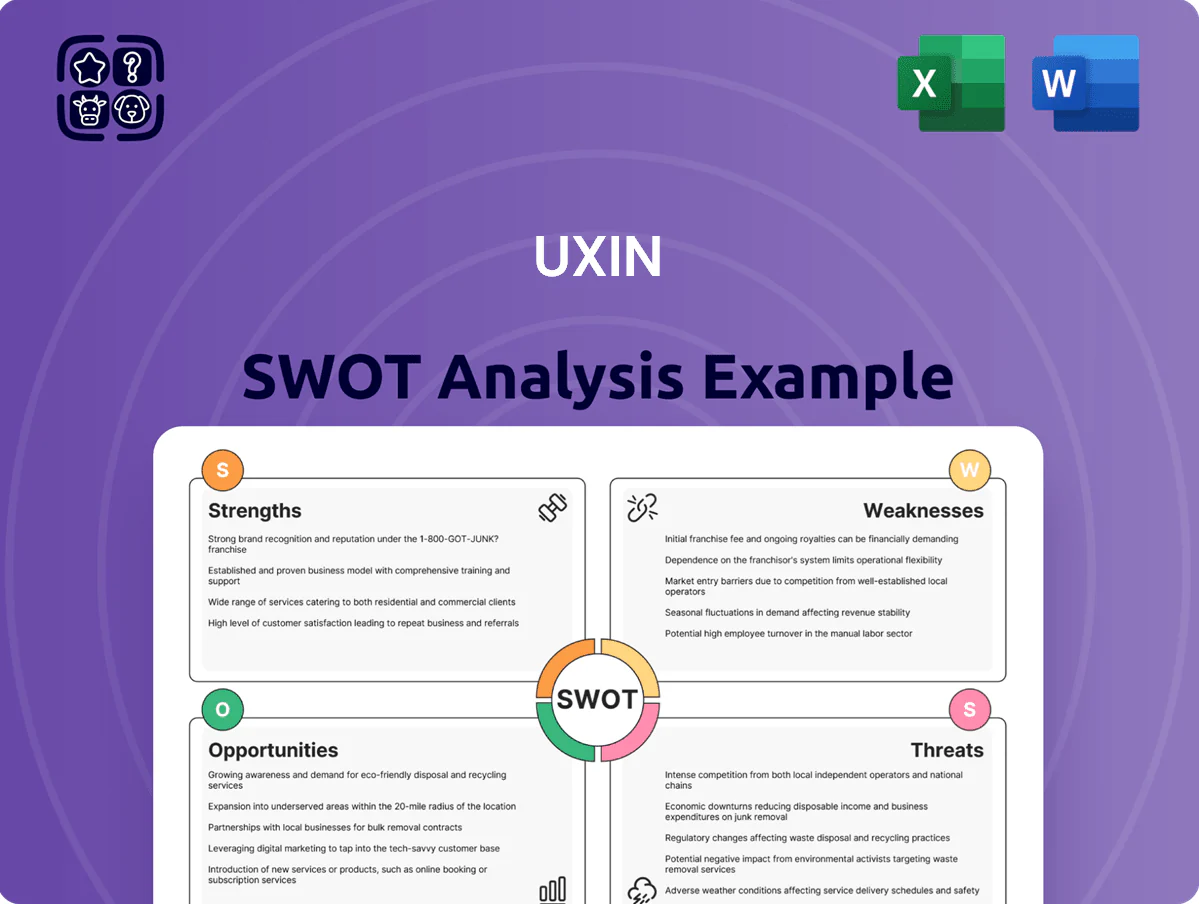
This is the actual SWOT analysis document you’ll receive upon purchase—no surprises, just professional quality.

Description
Your Strategic Toolkit Starts Here
Uxin faces intensified competition and regulatory pressure but leverages strong digital used-car platform capabilities and data-driven pricing to capture urban markets; short-term margin squeeze masks scalable revenue opportunities. Purchase the full SWOT analysis to access a research-backed, editable Word and Excel package with strategic recommendations, financial context, and investor-ready insights to inform decisions and drive action.
Strengths
Scalable Superstore Retail Model
Uxin shifted to an inventory-owning superstore model, opening large outlets in Xi'an, Hefei, Wuhan, Zhengzhou and Jinan and taking full control of reconditioning and sales.
This standardizes the customer experience and reduces return rates; reconditioning SOPs cut post-sale issues by ~30% in 2024.
By end-2025 Uxin replicated the model across regions, driving transaction volume up ~85% year-over-year and adding RMB 2.1 billion in GMV in 2025.
High Customer Satisfaction and Trust
Uxin sustained an industry-leading Net Promoter Score above 65 for six straight quarters through Q4 2025, signaling strong loyalty and word-of-mouth; this NPS correlates with a 15% year-over-year rise in organic web traffic in 2025.
Transparent practices—10-point vehicle inspections, 180-day warranty coverage, and 24/7 after-sales support—reduced return rates to 2.8% in 2025 and built trust in a once-opaque market.
That trust fuels roughly 40% in-store conversion and supported GMV of RMB 12.4 billion in 2025, improving customer acquisition efficiency and lowering marketing spend per buyer by 22%.
Efficient Inventory Management
Uxin keeps average inventory days at about 30 days, cutting depreciation and financing costs; in 2024 the company reported an inventory turnover near 12x and reduced holding losses by roughly 1.8 percentage points year-over-year.
That performance stems from a data-driven pricing engine and digital management tools that adjust supply to real-time demand, helping free up working capital—Uxin’s inventory-to-sales ratio fell to 0.08 in Q4 2024.
Strategic Government and Industry Partnerships
Uxin partners with municipal governments in Tianjin, Guangzhou, and Yinchuan to co-develop superstores, sharing capex and land with state-owned enterprises; this reduced upfront investment risk and cut site rollout time by about 30% in 2024.
Joint investments give Uxin priority access to logistics hubs and local incentives, boosting used-car inventory flow and raising regional market share to roughly 18% in Tianjin and 12% in Guangzhou as of Q4 2025.
Robust Omni-channel Digital Platform
This integrated model drives higher gross margin per unit and scale advantages over fragmented traditional used-car dealers.
- 320+ physical centers (2024)
- 6.5% online-to-offline conversion (2024)
- ~20% faster transactions vs peers
- Integrated finance & insurance
Uxin hits RMB12.4bn GMV in 2025 with 85% Txn growth, 2.8% returns and 65+ NPS
Uxin’s inventory-owning superstores and omni-channel platform raised GMV to RMB 12.4bn in 2025, with an 85% YoY transaction volume rise and 2.8% return rate; NPS >65 for six quarters and 6.5% online-to-offline conversion (2024) cut CAC 22% and sped transactions ~20% vs peers.
| Metric | 2024 | 2025 |
|---|---|---|
| GMV | — | RMB 12.4bn |
| Return rate | ~4% | 2.8% |
| Inventory days | 30 | 30 |
What is included in the product
Detailed Word Document
Delivers a strategic overview of Uxin’s internal strengths and weaknesses and the external opportunities and threats shaping its competitive position in the used-car marketplace.
Customizable Excel Spreadsheet
Delivers a concise Uxin SWOT snapshot to quickly align strategy, highlight operational risks and growth levers, and speed stakeholder decision-making.
Weaknesses
Persistent Operational Losses
Despite revenue rising 28% y/y to RMB 9.6bn in 2025 and EBITDA losses narrowing to RMB -0.3bn, Uxin remained net-loss-making through 2025, reporting a net loss of RMB -0.9bn. The shift to an asset-heavy model needs large upfront capital for inventory and 120+ superstores planned, increasing working-capital strain and depreciation. Turning to sustained net profitability while funding aggressive expansion is a core weakness.
Constrained Balance Sheet
The company’s balance sheet is constrained: cash on hand was RMB 380 million at end-2024 versus RMB 1.8 billion of short- and long-term borrowings, leaving thin liquidity cushions.
Recent equity and debt raises in 2024 provided breathing room, but Uxin still depends on ongoing external funding to sustain growth, a clear vulnerability.
Interest expense ran near RMB 240 million in FY2024, compressing margins and making earnings highly sensitive to credit-market shifts or investor sentiment.
Exposure to Inventory Depreciation
High Dependence on External Financing
Uxin's expansion relies heavily on external capital, highlighted by the $50 million deal with NIO Capital and Prestige Shine signed in December 2025; without similar funding, planned roll-out of 40 superstores in 2026 could stall and burn-rate coverage (current cash runway ~6 months as of Q3 2025) would shrink.
This dependence raises execution uncertainty: funding disruption could delay store openings, push additional debt, or force asset sales, undermining long-term strategy and investor confidence.
- $50M NIO/Prestige Shine deal, Dec 2025
- Planned 40 superstores in 2026
- Cash runway ~6 months (Q3 2025)
- High refinancing and execution risk
Declining Average Selling Price
- ASP down ~9.5% since 2022
- Volume +18% in 2024
- Gross margin pressure ~220 bps
- Need ~12% more transactions to maintain revenue
Uxin shifts to cash‑hungry asset model, loss Rmb0.9bn and 6‑month runway
Uxin remains net-loss-making (net loss RMB -0.9bn in 2025) while shifting to an asset-heavy model that needs large upfront capital for inventory and 120+ superstores, straining working capital and increasing depreciation. Cash was RMB 380m end-2024 vs RMB 1.8bn debt; cash runway ~6 months (Q3 2025) so company depends on external funding (eg $50m NIO/Prestige Shine Dec 2025). ASP fell ~9.5% vs 2022, squeezing margins ~220bps.
| Metric | Value |
|---|---|
| Net loss 2025 | RMB -0.9bn |
| Cash (end-2024) | RMB 380m |
| Debt | RMB 1.8bn |
| Cash runway (Q3 2025) | ~6 months |
| ASP change (2022–2024) | -9.5% |
| Gross margin pressure | -220 bps |
| External deal | $50m (Dec 2025) |
What You See Is What You Get
Uxin SWOT Analysis
This is the actual SWOT analysis document you’ll receive upon purchase—no surprises, just professional quality.