London Stock Exchange Group PESTLE Analysis

Make Smarter Strategic Decisions with a Complete PESTEL View
Stay ahead with our concise PESTLE snapshot of London Stock Exchange Group—highlighting regulatory pressures, macroeconomic sensitivity, fintech disruption, socio-demographic shifts, environmental expectations, and legal risks that will shape its trajectory; buy the full PESTLE for a complete, actionable breakdown and downloadable tools to support investment, strategy, or board-level decisions.
Political factors

Post-Brexit Regulatory Divergence
Geopolitical Trade Tensions
Ongoing geopolitical instability in Eastern Europe and the Middle East has increased market volatility, pushing LSEG's average daily traded value variance up ~18% in 2024 and pressuring trading volumes and risk-management service demand.
Trade tensions between Western economies and China are reshaping data sovereignty rules; 2024 regulatory actions in EU and APAC affected cross-border data flows for ~22% of LSEG’s data customers.
LSEG must align its global data footprint—already spanning 50+ jurisdictions—to reduce exposure to localized protectionist policies and safeguard revenue from information services and post-trade operations.

UK Government Listing Incentives
Political pressure to retain high-growth tech listings prompted UK reforms by late 2025, including formal approval of dual-class share structures and relaxed eligibility, contributing to a 22% rise in UK tech IPO activity in 2025 vs 2024.
These measures aim to reposition LSE as a premier IPO venue after several unicorns listed in New York; the UK saw £6.4bn of tech IPO proceeds in 2025, up from £4.2bn in 2024.
LSEG’s revenue exposure to primary markets makes its performance sensitive to the success of these initiatives: a 10% increase in IPO volumes could raise LSEG’s listing-related fee income by an estimated £40–60m annually.

European Clearing Equivalence
The political landscape over Euro-denominated derivatives clearing is pivotal for LSEG’s LCH; the EU granted temporary equivalence extensions through mid-2025 and again into 2026, while EU policy aims to shift clearing onshore, risking revenue—LCH cleared ~€2.1tn notional of interest-rate swaps in 2024, representing a material share of LCH’s €3.4tn aggregate cleared notional.
LSEG pursues high-level diplomacy with EU/UK authorities and clients to argue market-efficiency benefits of London-based clearing, citing concentration risks and potential cost increases if fragmentation occurs.
- EU temporary equivalence extended into 2026
- LCH cleared ~€2.1tn IRS notional in 2024
- Risk of onshoring threatens material fee revenue
- LSEG engaging regulators and clients to preserve efficiency
Data Sovereignty and Localization
Governments increasingly impose strict data residency rules; over 60 countries had data localization laws by 2024, affecting financial data flows. LSEG, with revenues of £6.6bn in FY2023, must invest in localized infrastructure and compliance across jurisdictions, raising capex and operating complexity. Non-compliance risks market exclusion and fines—e.g., GDPR penalties up to €20m or 4% of global turnover, and similar national penalties emerging.
- 60+ countries with localization laws (2024)
- LSEG FY2023 revenue £6.6bn—higher compliance burden
- Potential fines: GDPR up to €20m/4% turnover
- Localized infrastructure raises capex and operational complexity
UK reforms aim to boost listings as LSEG eyes IPO fee upside amid onshoring risks
| Metric | Value |
|---|---|
| UK market cap (2025) | £4.3tn |
| Non‑UK listings (2024) | 36% |
| LCH IRS notional (2024) | €2.1tn |
| Data localization laws (2024) | 60+ |
| LSEG rev (FY2023) | £6.6bn |
What is included in the product
 Detailed Word Document
Explores how macro-environmental forces uniquely influence London Stock Exchange Group across Political, Economic, Social, Technological, Environmental, and Legal dimensions, with data-driven trends and forward-looking insights tailored for executives, investors, and strategists to identify risks, opportunities, and scenario-based responses.

 Customizable Excel Spreadsheet
A compact, visually segmented PESTLE summary for London Stock Exchange Group that eases meeting prep, supports quick risk discussions and slide-ready snippets, and is editable for regional or business-line notes to align teams rapidly.
Economic factors

Interest Rate Environment
The shift from a high-rate cycle to stabilizing/declining rates in late 2025 boosts LSEG’s fixed income and clearing volumes; interest-rate swap notional outstanding rose to about $600tn globally in 2024–25, underpinning elevated hedging and trading where LSEG holds ~40% market share in cleared interest rate swaps.
Shift to Recurring Revenue Models
LSEG has shifted toward a high-margin subscription model after integrating Refinitiv and other data assets, with recurring revenue rising to about 55% of group revenue by FY2024 and forecast near 60% by end-2025, reducing reliance on volatile trading fees. This subscription mix increases EBITDA margin stability—group adjusted EBITDA margin reached ~44% in 2024—dampening sensitivity to market volumes. The recurring stream acts as a buffer in macro downturns, supporting cash flow predictability and debt coverage metrics.

Global Inflationary Pressures
Persistent inflation in service-led economies—UK CPI at 4.0% and US core PCE near 3.6% (2025 avg)—raises LSEG’s wage and tech infrastructure costs, notably for specialized data scientists and cloud services. LSEG’s pricing power can pass through some increases via subscription fees; FY2024 revenue resilience showed 6% recurring revenue growth. However, sustained high inflation risks reducing IPO volumes (global IPO value down ~22% in 2024) and M&A advisory activity, pressuring fee-based income. Monitoring the trade-off between rising opex and subscription price hikes remains a key priority.

Currency Exchange Volatility
As a global group reporting in GBP but earning ~70% of 2024 revenue in USD/EUR, LSEG faces material FX exposure; a 10% GBP appreciation vs USD in 2025 would compress reported revenues by roughly 7–8% on a constant-currency basis, creating accounting headwinds.
Stronger GBP vs USD in 2025 has already reduced FY2024–25 reported EPS; active hedging (forwards, options, natural hedges) is essential to stabilize shareholder returns and earnings volatility.
- ~70% revenues in USD/EUR
- 10% GBP move ≈ 7–8% revenue impact
- Hedging tools: forwards, options, natural hedges
- FX drives reported EPS volatility in 2024–25
Emerging Market Growth
Economic expansion in Southeast Asia (GDP growth ~4.6% in 2024) and the Middle East (regional GDP growth ~3.8% in 2024) offers LSEG geographic diversification opportunities as these markets deepen capital formation.
By supplying infrastructure and data to developing exchanges, LSEG can access new transaction and data revenue streams; EM trading volumes rose ~12% YoY in 2024, highlighting potential.
LSEG’s capture of this upside depends on recipient countries’ macro stability and progress on capital account liberalization, where reforms vary widely across jurisdictions.
- SEA & ME GDP growth 2024: ~4.6% / ~3.8%
- EM trading volumes +12% YoY (2024)
- Revenue upside contingent on macro stability and capital account reforms
LSEG: Clearing strength and recurring revenue offset FX risk as rates normalize
Interest-rate normalization into 2025 boosted cleared rates volumes (IR swap notional ~600tn in 2024–25) supporting LSEG’s clearing market share (~40%) and fixed-income revenues.
Recurring data/subscription revenue rose to ~55% of group revenue in FY2024, stabilizing adjusted EBITDA margin (~44%) and cash flow versus volatile capital markets fees.
FX exposure is material (≈70% revenues USD/EUR); a 10% GBP appreciation would cut reported revenues ~7–8%, pressuring EPS despite hedging.
| Metric | 2024–25 |
|---|---|
| IR swap notional | $600tn |
| Subscription revenue | ~55% (FY2024) |
| Adj. EBITDA margin | ~44% |
| Revenue in USD/EUR | ~70% |
| EM trading volumes YoY | +12% (2024) |
Full Version Awaits
London Stock Exchange Group PESTLE Analysis
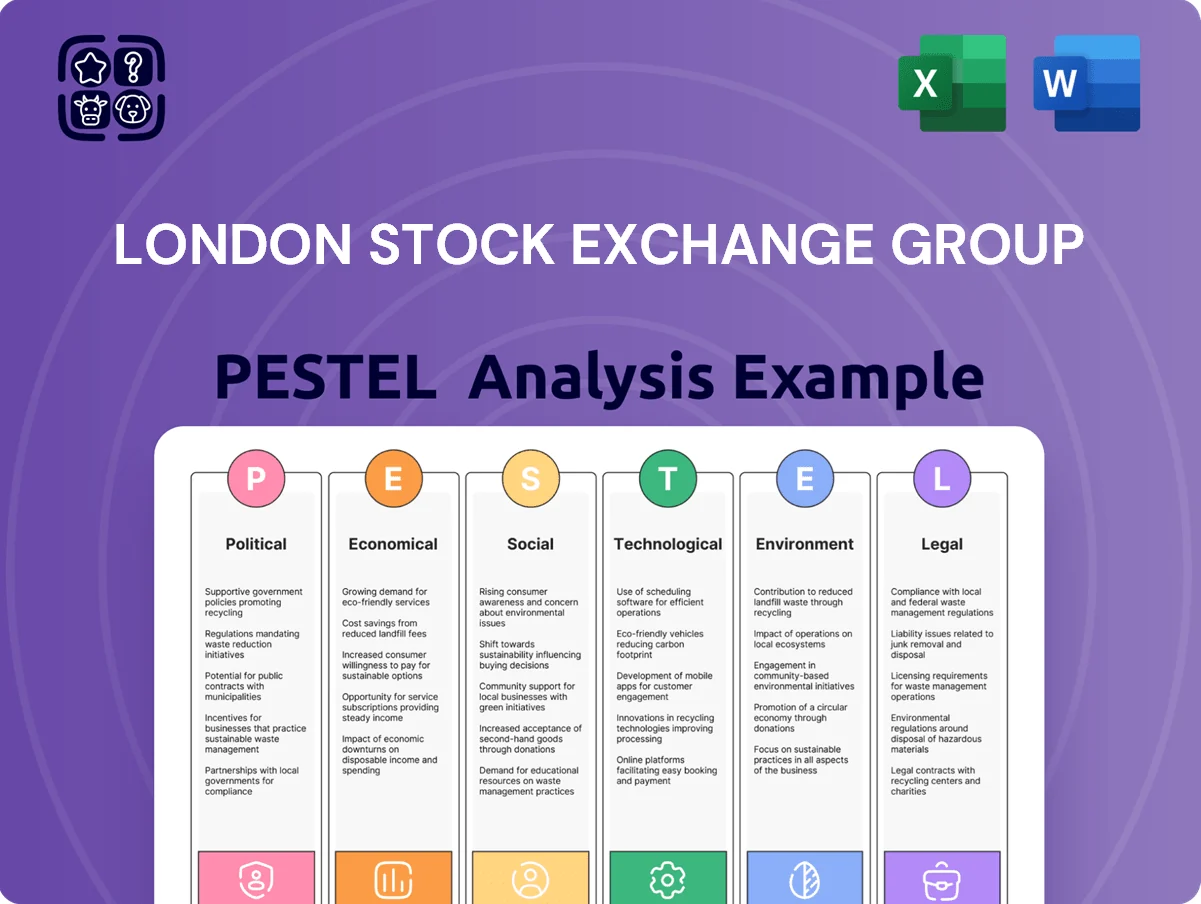
The preview shown here is the exact document you’ll receive after purchase—fully formatted and ready to use; this London Stock Exchange Group PESTLE analysis covers political, economic, social, technological, legal, and environmental factors with professional structure and no placeholders.

Description
Make Smarter Strategic Decisions with a Complete PESTEL View
Stay ahead with our concise PESTLE snapshot of London Stock Exchange Group—highlighting regulatory pressures, macroeconomic sensitivity, fintech disruption, socio-demographic shifts, environmental expectations, and legal risks that will shape its trajectory; buy the full PESTLE for a complete, actionable breakdown and downloadable tools to support investment, strategy, or board-level decisions.
Political factors
Post-Brexit Regulatory Divergence
Geopolitical Trade Tensions
Ongoing geopolitical instability in Eastern Europe and the Middle East has increased market volatility, pushing LSEG's average daily traded value variance up ~18% in 2024 and pressuring trading volumes and risk-management service demand.
Trade tensions between Western economies and China are reshaping data sovereignty rules; 2024 regulatory actions in EU and APAC affected cross-border data flows for ~22% of LSEG’s data customers.
LSEG must align its global data footprint—already spanning 50+ jurisdictions—to reduce exposure to localized protectionist policies and safeguard revenue from information services and post-trade operations.
UK Government Listing Incentives
Political pressure to retain high-growth tech listings prompted UK reforms by late 2025, including formal approval of dual-class share structures and relaxed eligibility, contributing to a 22% rise in UK tech IPO activity in 2025 vs 2024.
These measures aim to reposition LSE as a premier IPO venue after several unicorns listed in New York; the UK saw £6.4bn of tech IPO proceeds in 2025, up from £4.2bn in 2024.
LSEG’s revenue exposure to primary markets makes its performance sensitive to the success of these initiatives: a 10% increase in IPO volumes could raise LSEG’s listing-related fee income by an estimated £40–60m annually.
European Clearing Equivalence
The political landscape over Euro-denominated derivatives clearing is pivotal for LSEG’s LCH; the EU granted temporary equivalence extensions through mid-2025 and again into 2026, while EU policy aims to shift clearing onshore, risking revenue—LCH cleared ~€2.1tn notional of interest-rate swaps in 2024, representing a material share of LCH’s €3.4tn aggregate cleared notional.
LSEG pursues high-level diplomacy with EU/UK authorities and clients to argue market-efficiency benefits of London-based clearing, citing concentration risks and potential cost increases if fragmentation occurs.
- EU temporary equivalence extended into 2026
- LCH cleared ~€2.1tn IRS notional in 2024
- Risk of onshoring threatens material fee revenue
- LSEG engaging regulators and clients to preserve efficiency
Data Sovereignty and Localization
Governments increasingly impose strict data residency rules; over 60 countries had data localization laws by 2024, affecting financial data flows. LSEG, with revenues of £6.6bn in FY2023, must invest in localized infrastructure and compliance across jurisdictions, raising capex and operating complexity. Non-compliance risks market exclusion and fines—e.g., GDPR penalties up to €20m or 4% of global turnover, and similar national penalties emerging.
- 60+ countries with localization laws (2024)
- LSEG FY2023 revenue £6.6bn—higher compliance burden
- Potential fines: GDPR up to €20m/4% turnover
- Localized infrastructure raises capex and operational complexity
UK reforms aim to boost listings as LSEG eyes IPO fee upside amid onshoring risks
| Metric | Value |
|---|---|
| UK market cap (2025) | £4.3tn |
| Non‑UK listings (2024) | 36% |
| LCH IRS notional (2024) | €2.1tn |
| Data localization laws (2024) | 60+ |
| LSEG rev (FY2023) | £6.6bn |
What is included in the product
Detailed Word Document
Explores how macro-environmental forces uniquely influence London Stock Exchange Group across Political, Economic, Social, Technological, Environmental, and Legal dimensions, with data-driven trends and forward-looking insights tailored for executives, investors, and strategists to identify risks, opportunities, and scenario-based responses.
Customizable Excel Spreadsheet
A compact, visually segmented PESTLE summary for London Stock Exchange Group that eases meeting prep, supports quick risk discussions and slide-ready snippets, and is editable for regional or business-line notes to align teams rapidly.
Economic factors
Interest Rate Environment
The shift from a high-rate cycle to stabilizing/declining rates in late 2025 boosts LSEG’s fixed income and clearing volumes; interest-rate swap notional outstanding rose to about $600tn globally in 2024–25, underpinning elevated hedging and trading where LSEG holds ~40% market share in cleared interest rate swaps.
Shift to Recurring Revenue Models
LSEG has shifted toward a high-margin subscription model after integrating Refinitiv and other data assets, with recurring revenue rising to about 55% of group revenue by FY2024 and forecast near 60% by end-2025, reducing reliance on volatile trading fees. This subscription mix increases EBITDA margin stability—group adjusted EBITDA margin reached ~44% in 2024—dampening sensitivity to market volumes. The recurring stream acts as a buffer in macro downturns, supporting cash flow predictability and debt coverage metrics.
Global Inflationary Pressures
Persistent inflation in service-led economies—UK CPI at 4.0% and US core PCE near 3.6% (2025 avg)—raises LSEG’s wage and tech infrastructure costs, notably for specialized data scientists and cloud services. LSEG’s pricing power can pass through some increases via subscription fees; FY2024 revenue resilience showed 6% recurring revenue growth. However, sustained high inflation risks reducing IPO volumes (global IPO value down ~22% in 2024) and M&A advisory activity, pressuring fee-based income. Monitoring the trade-off between rising opex and subscription price hikes remains a key priority.
Currency Exchange Volatility
As a global group reporting in GBP but earning ~70% of 2024 revenue in USD/EUR, LSEG faces material FX exposure; a 10% GBP appreciation vs USD in 2025 would compress reported revenues by roughly 7–8% on a constant-currency basis, creating accounting headwinds.
Stronger GBP vs USD in 2025 has already reduced FY2024–25 reported EPS; active hedging (forwards, options, natural hedges) is essential to stabilize shareholder returns and earnings volatility.
- ~70% revenues in USD/EUR
- 10% GBP move ≈ 7–8% revenue impact
- Hedging tools: forwards, options, natural hedges
- FX drives reported EPS volatility in 2024–25
Emerging Market Growth
Economic expansion in Southeast Asia (GDP growth ~4.6% in 2024) and the Middle East (regional GDP growth ~3.8% in 2024) offers LSEG geographic diversification opportunities as these markets deepen capital formation.
By supplying infrastructure and data to developing exchanges, LSEG can access new transaction and data revenue streams; EM trading volumes rose ~12% YoY in 2024, highlighting potential.
LSEG’s capture of this upside depends on recipient countries’ macro stability and progress on capital account liberalization, where reforms vary widely across jurisdictions.
- SEA & ME GDP growth 2024: ~4.6% / ~3.8%
- EM trading volumes +12% YoY (2024)
- Revenue upside contingent on macro stability and capital account reforms
LSEG: Clearing strength and recurring revenue offset FX risk as rates normalize
Interest-rate normalization into 2025 boosted cleared rates volumes (IR swap notional ~600tn in 2024–25) supporting LSEG’s clearing market share (~40%) and fixed-income revenues.
Recurring data/subscription revenue rose to ~55% of group revenue in FY2024, stabilizing adjusted EBITDA margin (~44%) and cash flow versus volatile capital markets fees.
FX exposure is material (≈70% revenues USD/EUR); a 10% GBP appreciation would cut reported revenues ~7–8%, pressuring EPS despite hedging.
| Metric | 2024–25 |
|---|---|
| IR swap notional | $600tn |
| Subscription revenue | ~55% (FY2024) |
| Adj. EBITDA margin | ~44% |
| Revenue in USD/EUR | ~70% |
| EM trading volumes YoY | +12% (2024) |
Full Version Awaits
London Stock Exchange Group PESTLE Analysis
The preview shown here is the exact document you’ll receive after purchase—fully formatted and ready to use; this London Stock Exchange Group PESTLE analysis covers political, economic, social, technological, legal, and environmental factors with professional structure and no placeholders.