Derby Cycle AG SWOT Analysis

Go Beyond the Preview—Access the Full Strategic Report
Derby Cycle AG’s SWOT analysis highlights resilient brand heritage and diverse product range, tempered by supply-chain pressures and intensifying e-bike competition; strategic shifts and geographic expansion offer upside but require capital and execution precision. Discover the full report for actionable, research-backed insights, editable deliverables, and investor-ready recommendations to inform strategy and investment decisions—purchase the complete SWOT to access Word and Excel versions instantly.
Strengths

Dominant Brand Portfolio
Derby Cycle AG holds a dominant market position via established brands Kalkhoff, Focus, and Raleigh, which together accounted for roughly €780m of group revenue in 2024, about 85% of total sales.
Each brand targets distinct segments—Kalkhoff for urban e-bikes, Focus for high-performance road and gravel, Raleigh for heritage and value—covering commuter to competitive riders.
This multi-brand strategy captured diverse demographics and price points, supporting a 2024 gross margin near 28% and reducing revenue volatility across cycles.
Integration with Pon Bike Global Network
Integration with Pon.Bike gives Derby Cycle AG access to Pon’s global distribution reaching 70+ countries and group purchasing power that cut component costs by an estimated 8–12% versus stand‑alone peers in 2024; Pon’s balance sheet (Pon Holdings revenue €6.5bn in 2023) supplies superior capital for fleet electrification and inventory financing.

Pioneering E-Bike Innovation
Derby Cycle AG pioneered electric drive adoption and, by 2025, e-bike sales accounted for ~68% of group volume, reflecting leadership in integration and market traction.
German engineering teams focus on seamless battery integration and proprietary mid-drive motor tuning, cutting warranty claims to 0.9% in 2024 versus industry ~2.5%.
The firm’s technical depth made its models benchmarks for reliability and performance, supporting a 2024 gross margin uplift of ~350 basis points in its e-mobility segment.

Advanced Manufacturing Facilities
The Cloppenburg site is one of Europe’s most advanced bicycle hubs, producing ~120,000 units annually in 2024 and employing ~850 staff; high automation plus German engineering cut defect rates below 0.7% and speed prototyping to under 6 weeks.
Local production yields tighter quality control and 20% faster time-to-market for EU launches, supporting Derby Cycle AG’s 2024 gross margin resilience (approx. 22%).
- ~120,000 units/year (2024)
- ~850 employees
- defect rate <0.7%
- prototyping <6 weeks
- 20% faster EU time-to-market
- 2024 gross margin ~22%
Extensive Retailer Network
Derby Cycle AG maintains a vast, loyal network of ~1,200 independent dealers across Europe, with ~45% of retail points in the DACH region, giving it durable reach and recurring service revenue (2024 parts & service ~€48m).
These long-term partnerships create a high barrier to entry—new entrants lack established after-sales locations—supporting Derby’s high-end brand prestige and hands-on customer support.
- ~1,200 dealers Europe-wide
- ~45% dealers in DACH
- 2024 parts & service revenue ≈ €48m
- Strong after-sales network = barrier to entry
Derby Cycle: €780M brands, 68% e-bike mix, 28% margin, 120k units, 1,200 dealers
Derby Cycle AG’s strengths: dominant brands (Kalkhoff, Focus, Raleigh) driving ~€780m (85%) of 2024 revenue; e-bikes ~68% of volume by 2025; gross margin ~28% (group) with e-mobility +350bps; Cloppenburg: ~120,000 units, ~850 staff, defect <0.7%; dealer network ~1,200 stores, parts & service ≈€48m (2024).
| Metric | 2024/2025 |
|---|---|
| Revenue from key brands | ~€780m |
| E-bike share (vol) | ~68% |
| Group gross margin | ~28% |
| Cloppenburg output | ~120,000 units |
| Dealers | ~1,200 |
What is included in the product
 Detailed Word Document
Provides a concise SWOT analysis of Derby Cycle AG, highlighting its core strengths, operational weaknesses, market opportunities, and external threats to assess strategic positioning and future growth prospects.

 Customizable Excel Spreadsheet
Provides a concise SWOT matrix for Derby Cycle AG to quickly align strategy and communicate competitive positioning to stakeholders.
Weaknesses

High Production Cost Base
Maintaining major manufacturing in Germany drives higher labor costs—around €45–€50/hour vs €3–€8 in Southeast Asia—pushing 2024 gross margins down to ~18.5% vs sector peers at ~24%; quality gains help, but margin pressure rises in slow demand.
Complexity of Brand Management
Managing multiple brands strains Derby Cycle AG: 2024 revenue of €675M came from several labels, raising internal competition and fragmented marketing spend (estimated €22–28M across brands). Focus and Kalkhoff risk cannibalising urban-trekking sales—both target similar price points (€1,200–€2,500) and grew 8–12% in 2023, so overlap is real. Streamlining identities while protecting heritage equity is a continual strategic challenge for management.

Slow Direct to Consumer Transition
Derby Cycle still sells ~80% through dealers while D2C leaders like Canyon report >60% online sales, leaving Derby with lower gross margins—dealer markups can cut 10–25 percentage points of margin. Digital sales growth lags: Derby’s e‑commerce <15% of revenue in 2024 versus sector peers at 40–60%. Moving to a hybrid model risks alienating dealers who account for 70–85% of service and repeat sales.

Dependence on European Markets
Derby Cycle AG earns roughly 70% of revenue from the EU, leaving it exposed to regional slowdowns; Germany and Benelux retail sentiment heavily influence brand sales, while Pon.Bike’s global reach has not fully shifted Derby’s geographic mix.
Diversifying outside Europe is urgent: in 2024 EU GDP growth slowed to 1.5% vs global 3.8%, and a 10% regional revenue drop would cut group sales by ~7 percentage points.
Operational Integration Friction
Being part of Pon Holdings (Netherlands), which reported €6.5 billion revenue in 2024, can create bureaucratic delays that slow Derby Cycle AG’s decisions in Germany.
Aligning Derby’s niche e-bike and urban-mobility goals with Pon’s global strategy needs constant negotiation, delaying market-specific moves.
Such friction can slow product pivots and time-to-market, impacting revenue growth—Derby Cycle’s 2023 EBITDA margin of ~6–8% shows limited buffer.
- Bureaucratic delays due to parent scale
- Frequent strategy negotiations with Pon
- Slower niche-market pivots and launches
- Thin EBITDA margin magnifies impact
High costs, low e‑commerce & EU concentration squeeze margins and resilience
Weaknesses: high German manufacturing costs (~€45–€50/hr) compress gross margin (~18.5% in 2024 vs peers ~24%); fragmented multi-brand structure (2024 revenue €675M; marketing ~€25M) causes internal cannibalisation; low e‑commerce (<15% of sales) and 80% dealer reliance reduce margins and digital growth; ~70% EU revenue exposure risks regional slowdown (10% EU drop ≈ -7% group sales); thin EBITDA (~6–8%) limits shock absorption.
| Metric | 2024 | Peer/Note |
|---|---|---|
| Revenue | €675M | — |
| Gross margin | ~18.5% | Peers ~24% |
| E‑commerce | <15% | Peers 40–60% |
| EU revenue share | ~70% | High regional exposure |
| EBITDA margin | ~6–8% | Thin buffer |
Preview Before You Purchase
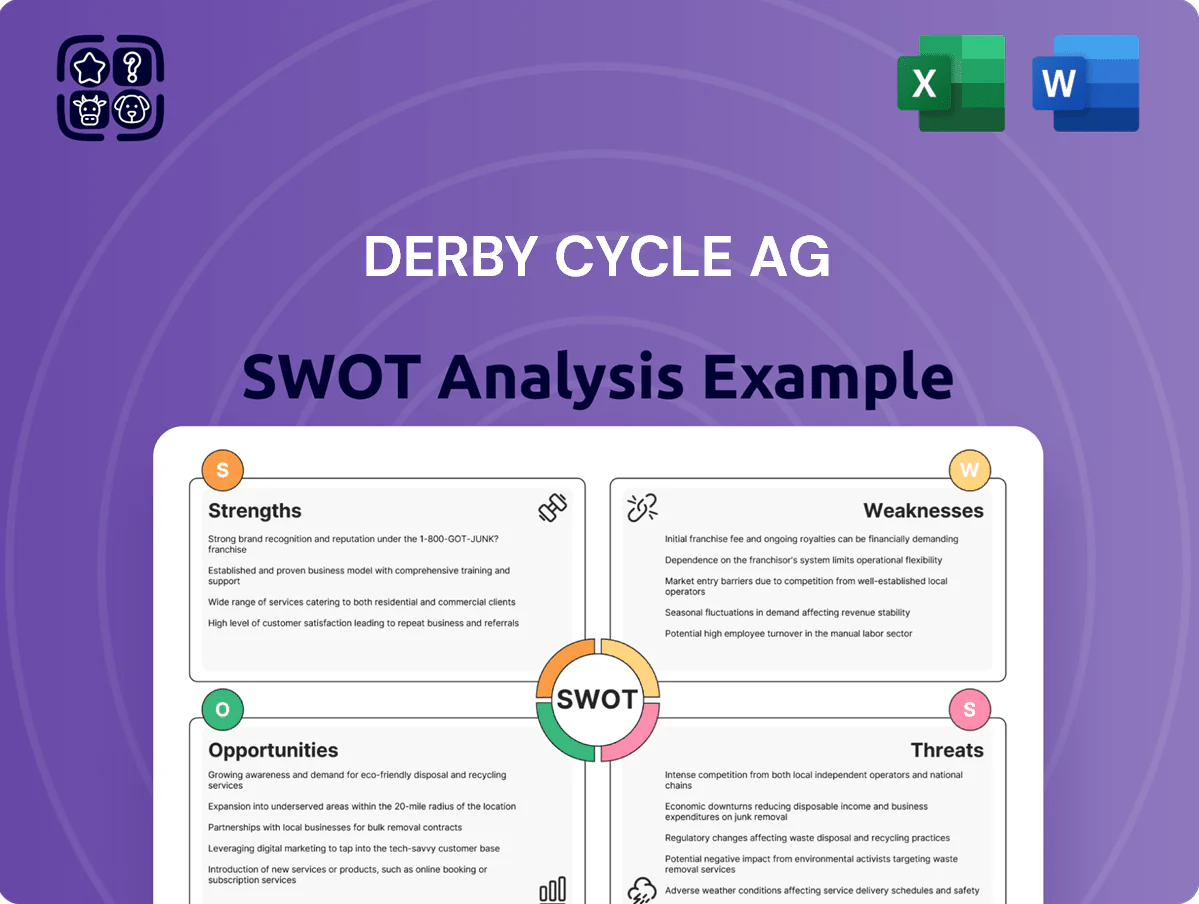
Derby Cycle AG SWOT Analysis
This is the actual SWOT analysis document you’ll receive upon purchase—no surprises, just professional quality.

Description
Go Beyond the Preview—Access the Full Strategic Report
Derby Cycle AG’s SWOT analysis highlights resilient brand heritage and diverse product range, tempered by supply-chain pressures and intensifying e-bike competition; strategic shifts and geographic expansion offer upside but require capital and execution precision. Discover the full report for actionable, research-backed insights, editable deliverables, and investor-ready recommendations to inform strategy and investment decisions—purchase the complete SWOT to access Word and Excel versions instantly.
Strengths
Dominant Brand Portfolio
Derby Cycle AG holds a dominant market position via established brands Kalkhoff, Focus, and Raleigh, which together accounted for roughly €780m of group revenue in 2024, about 85% of total sales.
Each brand targets distinct segments—Kalkhoff for urban e-bikes, Focus for high-performance road and gravel, Raleigh for heritage and value—covering commuter to competitive riders.
This multi-brand strategy captured diverse demographics and price points, supporting a 2024 gross margin near 28% and reducing revenue volatility across cycles.
Integration with Pon Bike Global Network
Integration with Pon.Bike gives Derby Cycle AG access to Pon’s global distribution reaching 70+ countries and group purchasing power that cut component costs by an estimated 8–12% versus stand‑alone peers in 2024; Pon’s balance sheet (Pon Holdings revenue €6.5bn in 2023) supplies superior capital for fleet electrification and inventory financing.
Pioneering E-Bike Innovation
Derby Cycle AG pioneered electric drive adoption and, by 2025, e-bike sales accounted for ~68% of group volume, reflecting leadership in integration and market traction.
German engineering teams focus on seamless battery integration and proprietary mid-drive motor tuning, cutting warranty claims to 0.9% in 2024 versus industry ~2.5%.
The firm’s technical depth made its models benchmarks for reliability and performance, supporting a 2024 gross margin uplift of ~350 basis points in its e-mobility segment.
Advanced Manufacturing Facilities
The Cloppenburg site is one of Europe’s most advanced bicycle hubs, producing ~120,000 units annually in 2024 and employing ~850 staff; high automation plus German engineering cut defect rates below 0.7% and speed prototyping to under 6 weeks.
Local production yields tighter quality control and 20% faster time-to-market for EU launches, supporting Derby Cycle AG’s 2024 gross margin resilience (approx. 22%).
- ~120,000 units/year (2024)
- ~850 employees
- defect rate <0.7%
- prototyping <6 weeks
- 20% faster EU time-to-market
- 2024 gross margin ~22%
Extensive Retailer Network
Derby Cycle AG maintains a vast, loyal network of ~1,200 independent dealers across Europe, with ~45% of retail points in the DACH region, giving it durable reach and recurring service revenue (2024 parts & service ~€48m).
These long-term partnerships create a high barrier to entry—new entrants lack established after-sales locations—supporting Derby’s high-end brand prestige and hands-on customer support.
- ~1,200 dealers Europe-wide
- ~45% dealers in DACH
- 2024 parts & service revenue ≈ €48m
- Strong after-sales network = barrier to entry
Derby Cycle: €780M brands, 68% e-bike mix, 28% margin, 120k units, 1,200 dealers
Derby Cycle AG’s strengths: dominant brands (Kalkhoff, Focus, Raleigh) driving ~€780m (85%) of 2024 revenue; e-bikes ~68% of volume by 2025; gross margin ~28% (group) with e-mobility +350bps; Cloppenburg: ~120,000 units, ~850 staff, defect <0.7%; dealer network ~1,200 stores, parts & service ≈€48m (2024).
| Metric | 2024/2025 |
|---|---|
| Revenue from key brands | ~€780m |
| E-bike share (vol) | ~68% |
| Group gross margin | ~28% |
| Cloppenburg output | ~120,000 units |
| Dealers | ~1,200 |
What is included in the product
Detailed Word Document
Provides a concise SWOT analysis of Derby Cycle AG, highlighting its core strengths, operational weaknesses, market opportunities, and external threats to assess strategic positioning and future growth prospects.
Customizable Excel Spreadsheet
Provides a concise SWOT matrix for Derby Cycle AG to quickly align strategy and communicate competitive positioning to stakeholders.
Weaknesses
High Production Cost Base
Maintaining major manufacturing in Germany drives higher labor costs—around €45–€50/hour vs €3–€8 in Southeast Asia—pushing 2024 gross margins down to ~18.5% vs sector peers at ~24%; quality gains help, but margin pressure rises in slow demand.
Complexity of Brand Management
Managing multiple brands strains Derby Cycle AG: 2024 revenue of €675M came from several labels, raising internal competition and fragmented marketing spend (estimated €22–28M across brands). Focus and Kalkhoff risk cannibalising urban-trekking sales—both target similar price points (€1,200–€2,500) and grew 8–12% in 2023, so overlap is real. Streamlining identities while protecting heritage equity is a continual strategic challenge for management.
Slow Direct to Consumer Transition
Derby Cycle still sells ~80% through dealers while D2C leaders like Canyon report >60% online sales, leaving Derby with lower gross margins—dealer markups can cut 10–25 percentage points of margin. Digital sales growth lags: Derby’s e‑commerce <15% of revenue in 2024 versus sector peers at 40–60%. Moving to a hybrid model risks alienating dealers who account for 70–85% of service and repeat sales.
Dependence on European Markets
Derby Cycle AG earns roughly 70% of revenue from the EU, leaving it exposed to regional slowdowns; Germany and Benelux retail sentiment heavily influence brand sales, while Pon.Bike’s global reach has not fully shifted Derby’s geographic mix.
Diversifying outside Europe is urgent: in 2024 EU GDP growth slowed to 1.5% vs global 3.8%, and a 10% regional revenue drop would cut group sales by ~7 percentage points.
Operational Integration Friction
Being part of Pon Holdings (Netherlands), which reported €6.5 billion revenue in 2024, can create bureaucratic delays that slow Derby Cycle AG’s decisions in Germany.
Aligning Derby’s niche e-bike and urban-mobility goals with Pon’s global strategy needs constant negotiation, delaying market-specific moves.
Such friction can slow product pivots and time-to-market, impacting revenue growth—Derby Cycle’s 2023 EBITDA margin of ~6–8% shows limited buffer.
- Bureaucratic delays due to parent scale
- Frequent strategy negotiations with Pon
- Slower niche-market pivots and launches
- Thin EBITDA margin magnifies impact
High costs, low e‑commerce & EU concentration squeeze margins and resilience
Weaknesses: high German manufacturing costs (~€45–€50/hr) compress gross margin (~18.5% in 2024 vs peers ~24%); fragmented multi-brand structure (2024 revenue €675M; marketing ~€25M) causes internal cannibalisation; low e‑commerce (<15% of sales) and 80% dealer reliance reduce margins and digital growth; ~70% EU revenue exposure risks regional slowdown (10% EU drop ≈ -7% group sales); thin EBITDA (~6–8%) limits shock absorption.
| Metric | 2024 | Peer/Note |
|---|---|---|
| Revenue | €675M | — |
| Gross margin | ~18.5% | Peers ~24% |
| E‑commerce | <15% | Peers 40–60% |
| EU revenue share | ~70% | High regional exposure |
| EBITDA margin | ~6–8% | Thin buffer |
Preview Before You Purchase
Derby Cycle AG SWOT Analysis
This is the actual SWOT analysis document you’ll receive upon purchase—no surprises, just professional quality.